Which starting hands to play
Play about one hand in eight when you are first to act, and about two in five when you are last. There are 169 distinct starting hands in Texas Hold’em and most of them are not worth playing, but which ones qualify depends on where you are sitting, because acting last is worth more than almost any pair of cards.
That is the answer, and it is why the chart below is arranged by position rather than by strength. Most starting-hand charts tell you what to play. The useful question is when.
The chart
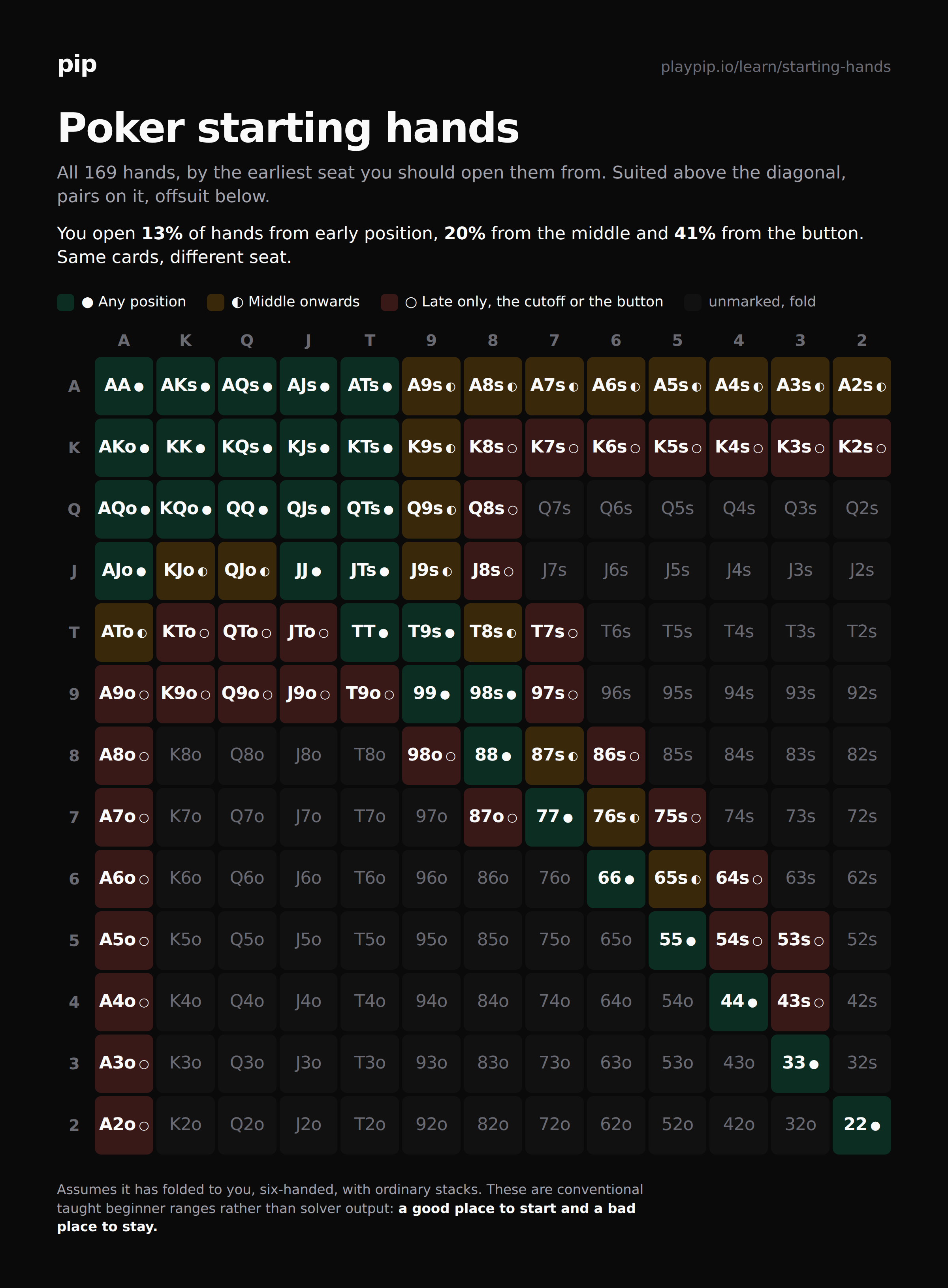
The action has folded to you and you are deciding whether to come in. Find your two cards, and the colour and symbol tell you the earliest seat you should open them from. Tap any hand for the detail.
Suited hands are above the diagonal, pairs are on it, offsuit hands are below.
- ● Any position
- ◐ Middle onwards
- ○ Late only, the cutoff or the button
- unmarked, fold
| Higher card | A | K | Q | J | T | 9 | 8 | 7 | 6 | 5 | 4 | 3 | 2 |
|---|---|---|---|---|---|---|---|---|---|---|---|---|---|
| A | |||||||||||||
| K | |||||||||||||
| Q | |||||||||||||
| J | |||||||||||||
| T | |||||||||||||
| 9 | |||||||||||||
| 8 | |||||||||||||
| 7 | |||||||||||||
| 6 | |||||||||||||
| 5 | |||||||||||||
| 4 | |||||||||||||
| 3 | |||||||||||||
| 2 |
Tap any hand for what it is, when it plays and how often it turns up.
That works out at 13% of hands from early position, 20% from the middle, and 41% from the button. The set roughly triples between the first seat and the last, and the cards did not change. Your seat did.
Read this chart as a floor, not a law. It assumes nobody has raised in front of you, a six-handed table and stacks of a normal depth. It is a conventional beginner range rather than anything solved, and any strong player would adjust it constantly. It is a good place to start and a bad place to stay.
Why position changes the answer at all
You are not being asked to guess whether your two cards are good. You are being asked whether they will still be good after four rounds of betting against people you cannot see.
Acting last means you have watched everyone else act before you decide. You get more information for the same money, every round, for the whole hand. That is worth more than most of the difference between one starting hand and another, which is why a hand like J9s is a fold from the first seat and a routine open from the button. The position guide is the long version.
The other half of it is how many people are left behind you. From early position five players still get to wake up with a better hand. From the button there are two. The same cards are simply likelier to be best when fewer people can beat them.
What actually makes a hand worth playing
Four things, and they matter in this order.
High cards. Most hands never improve past one pair, so the pair you make wants to be a big one. This is the whole reason ace-king beats king-queen and king-queen beats queen-jack. Nothing clever in it.
Being a pair already. You start with a made hand nobody has to help you find. Pocket pairs are rare, at 5.9% of hands, and small ones are worth playing mostly because of what they can become: a pocket pair flops a set or better 11.8% of the time, which is once in every eight and a half hands. That is the whole business case for playing 44.
Cards that work together. Connected cards make straights, and cards close in rank make more straights than distant ones. 76 belongs to four possible straights. Put one gap between them and 86 belongs to three. King-seven belongs to none at all, because no run of five ranks holds both.
Being suited. This one is real and it is smaller than people think. Two suited cards make a flush by the river 6.4% of the time, so a flush is not the plan, it is a bonus. Priced properly:
| Hand | Equity against a fixed opponent | What the suits are worth |
|---|---|---|
| A♠K♠ against Q♣Q♦ | 46.2% | |
| A♠K♥ against Q♣Q♦ | 42.8% | 3.4 points for the suits |
| 7♠6♠ against T♣T♦ | 21.6% | |
| 7♠6♥ against T♣T♦ | 17.8% | 3.8 points for the suits |
So suitedness is worth about three to four points. It is a tiebreaker, not a transformation. It is usually enough to move a hand one band on the chart above, which is exactly what it does: ATs is playable from anywhere and ATo waits for the middle. It is not enough to make two low suited cards worth playing, and “but they were suited” has probably cost more beginners more money than any other sentence in poker.
The four traps
Any ace. A5o and A9o are on the chart from late position only, and for a reason. When your ace pairs, you have top pair with a bad kicker, and the way that hand loses is to somebody with the same pair and a better one. It wins small pots and loses big ones. Ace-rag is the most reliably overplayed hand in poker, and it is kickers doing the damage.
Any two suited cards. 6.4%. See above.
Face cards that do not match. KJo, QJo and JTo look like a handful of picture cards. They make second-best pairs against exactly the hands that raise, which is the definition of an expensive holding. Note where they sit on the chart, which is later than they feel.
Playing a hand because you are bored. Most of poker is folding. From the first seat this chart folds 87% of the time, and the discipline to do that is worth more than any refinement to which hands are in the other 13%.
How often you actually get the good stuff
Worth knowing, because it sets expectations for a session and stops the chart feeling unfairly tight.
| You are dealt | How often | Roughly |
|---|---|---|
| Any pocket pair | 5.88% | 1 in 17 hands |
| Aces, kings or queens | 1.36% | 1 in 74 |
| Ace-king, suited or not | 1.21% | 1 in 83 |
| A named pair, say aces | 0.45% | 1 in 221 |
| A named suited hand, say ace-king suited | 0.30% | 1 in 332 |
Aces arrive once in 221 hands. At a normal pace that is a couple of hours. The tight-looking chart above is not asking you to wait for aces, and if you sit waiting for aces you will pay far more in blinds than they will ever win you. Most of the money is made with hands that are merely good, in seats where being merely good is enough.
A chart is a memory aid for a decision you have to make in about four seconds, and it only becomes automatic by making it a few hundred times. That part cannot be read.
You can play Texas Hold’em on Pip right now, in the browser, against opponents that actually play. No account needed, nothing to install, no money involved anywhere and none to spend. Your position moves every hand, so the interesting half of this page turns up on its own, several times a minute.
Take this chart
The chart on this page is free to use anywhere. Repost it, print it, put it in an article, hand it round at a home game. Commercial sites included, no permission needed and nobody to ask.
The whole grid as one picture: playpip.io/learn/starting-hands-chart.png. It is drawn from the same list of hands as the chart above, so the two cannot disagree with each other. Hotlink it or keep your own copy, whichever suits you.
A credit is welcome and not required. If you want to leave one, this is all of it:
<a href="https://playpip.io/learn/starting-hands">
  <img src="https://playpip.io/learn/starting-hands-chart.png"
       alt="Texas Hold’em starting hand chart: all 169 starting hands in a 13x13 grid, each marked with the earliest position it is worth opening from."
       width="2400" height="3262">
</a>
<p>Chart from <a href="https://playpip.io/learn/starting-hands">Which starting hands to play</a> by <a href="https://playpip.io">Pip</a></p>